

 Rings
Rings
 Earrings
 Bracelets & Bangles
 Necklaces & Pendants
 Silver Jewellery


 Our Story
 Diamond Buying Guide
 Watch Buying Guide
 Product Care & Aftercare
 Visit our Showroom
Selecting the setting for a solitaire diamond requires balancing visual presence against physical retention. When inspecting ring mounts in a showroom, buyers often focus on the side profile or the thickness of the metal shank, treating the claws that hold the diamond as minor details. In daily wear, however, those slender uprights of gold or platinum represent the only mechanical barrier keeping your centre stone secured to the ring.
At the goldsmith's bench, choosing between a four-prong and a six-prong mount involves structural physics, optical geometry, and lifestyle suitability. When mounting stones for engagement rings, craftsmen assess how prong spacing influences the apparent shape of the stone, what happens when a claw snags on clothing, and how diamond diameter dictates metal proportions. Understanding these trade-offs ensures you select a mount that protects your diamond without overwhelming its brilliance.
Prong Anatomy: How Goldsmiths Seat a Diamond
To understand why prong count matters, you must understand how a setter anchors a diamond into precious metal.
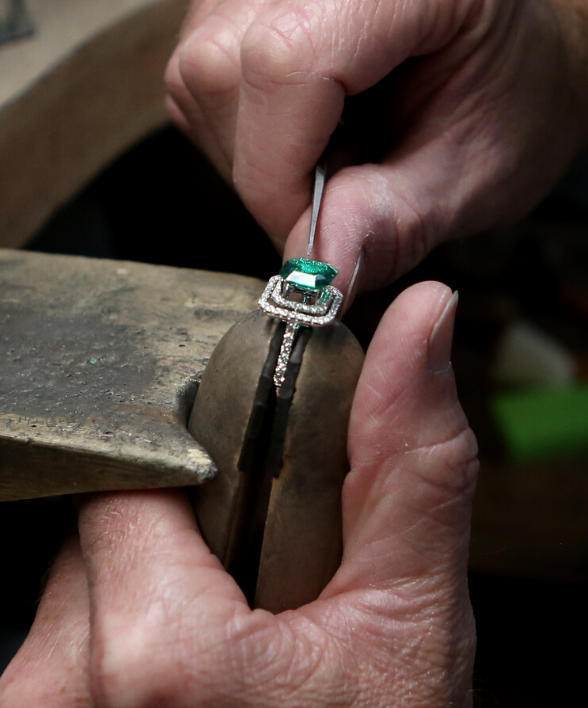
Prongs are not simply bent over the top of a stone like wire fingers. A master setter uses a hardened steel burr to cut an exact horizontal notch—called a seat—into the inside wall of each metal upright. The thin outer edge of the diamond (the girdle) rests firmly inside these cut seats.
Once the diamond sits level, the setter uses hand tools to push the tips of the claws down over the upper crown facets, burnishing the metal into smooth, rounded beads or pointed talon tips. The stone is held securely by the opposing inward tension of the prongs. The balance and number of these tension points dictate how the ring performs when exposed to daily impacts.
The Four-Prong Setting: Clean Lines and Visual Openness
The four-prong mount positions claws at four equidistant corners—either at ninety-degree intervals (the traditional box configuration) or rotated into an X-shape (the compass setting).
Maximum Diamond Visibility: By reducing the amount of metal covering the stone, a four-prong setting leaves more of the diamond visible from side angles. The girdle and upper crown facets remain clear, giving the stone an open, unobstructed presentation on the finger.
Balanced for Smaller Carats: On diamonds measuring under 0.75 carats (roughly 5.8 millimetres in diameter), a four-prong mount provides ideal proportions. Four petite claws secure the perimeter without crowding the stone’s surface area, allowing a modest diamond to maximize its face-up spread.
The Squaring Optical Effect: Four prongs placed at compass or diagonal points create a subtle optical illusion: they tend to give a round brilliant diamond a slightly square or cushion-like silhouette from a distance. Some wearers admire this architectural geometry, while others prefer to emphasize circular symmetry.
The Mechanical Vulnerability: The primary trade-off of a four-prong setting is the lack of redundancy. Each claw holds 25 percent of the stone. If one claw is bent back by a heavy knitwear snag or sheared off against a hard surface, the opposing tension fails entirely, and the diamond will almost certainly fall out of the mount.
The Six-Prong Setting: Mechanical Redundancy and Circular Symmetry
The six-prong setting—first popularized in 1886 with the original Tiffany solitaire—spaces claws at sixty-degree intervals around the diamond's perimeter.
True Structural Redundancy: The greatest benefit of a six-prong mount is physical security. Because six points of contact share the load, each claw holds approximately 16.6 percent of the stone's circumference. If a single claw catches on a pocket and bends outward, the remaining five prongs maintain balanced tension, keeping the diamond trapped inside its seats until you can reach a workshop for repair.
Emphasizing Roundness: Spacing six claws evenly around an ellipse or circle visually reinforces the round geometry of a brilliant cut. Rather than squaring the edges, the six points trace the circular curve of the girdle, making the diamond appear rounder from every viewing angle.
Girdle Impact Defense: The thin girdle edge of a diamond is its most vulnerable area for chipping if struck directly against granite countertops or metal railings. Six evenly spaced claws act as miniature metal bumpers, deflecting lateral blows away from the crystalline edge.
The Surface Coverage Trade-Off: On smaller diamonds, six prongs can cover a noticeable percentage of the stone's top table and crown, making the gem look crowded by metal. Six-prong mounts generally perform best on diamonds of 0.80 carats and larger (above 6.0 millimetres in diameter), where the stone has sufficient surface area to support the extra metal work.
Side-by-Side Comparison: 4 Prongs vs. 6 Prongs
The table below contrasts the mechanical safety, optical traits, and bench maintenance expectations of both configurations.
| Design Factor | Four-Prong Mount | Six-Prong Mount |
|---|---|---|
| Mechanical Redundancy | Low; failure of one claw causes immediate loss of stone | High; stone remains captured if one claw bends or snaps |
| Visual Diamond Silhouette | Squares off the profile; gives a subtle geometric look | Reinforces circular outline; emphasizes round symmetry |
| Side Profile Openness | High; reveals maximum girdle and pavilion surface | Moderate; additional metal uprights frame the pavilion |
| Minimum Ideal Carat Weight | Suitable for all sizes; exceptional under 0.75ct | Recommended for 0.80ct and larger stones |
| Girdle Impact Protection | Moderate; large sections of exposed girdle between claws | High; prongs serve as protective perimeter bumpers |
| Cleaning Access Beneath Table | Wide gaps allow easier access for toothbrush bristles | Tighter spaces between prongs require ultrasonic cleaning |
The Light Entry Myth: Debunking Side Illumination
A common retail misconception is that a four-prong setting makes a diamond sparkle noticeably more than a six-prong setting because it "lets more light in from the sides."
In gemmology and optical physics, diamonds do not rely on light entering from the sides to create brilliance. A diamond is a high-refractive-index prism (refractive index 2.42). Light entering from the side of the pavilion strikes interior facets at shallow angles and leaks straight out through the opposite side without returning to your eye.
True sparkle—brilliance and dispersion—is driven almost entirely by ambient light entering through the top table facet and upper crown facets. That light travels down into the pavilion, bounces between calibrated internal facet angles, and reflects directly back up to the viewer. Because both four- and six-prong settings leave the top table completely open to ambient light, claw count has virtually no measurable impact on a diamond's light return.
Claw Finishing: Round Beads vs. Talon Claws
The visual impact of any prong setting depends heavily on how the tips of the claws are shaped at the bench.
- Traditional Round Beads: The setter rounds the tip of each prong into a smooth, spherical dome. This classic finish feels comfortable against skin and provides substantial metal mass over the girdle, though it covers slightly more surface area on the stone.
- Petite Talon / Claw Prongs: The goldsmith files the tip of each prong into a sharp, delicate point that tapers inward over the crown. Talon prongs provide high mechanical grip while presenting a minimal visual footprint, giving either a four-prong or six-prong setting an architectural, modern feel.
Workshop Maintenance and Claw Inspection Schedules
Regardless of whether you choose four or six claws, prongs undergo continuous friction from daily contact with knitwear, coat pockets, and hard surfaces.
Gold and platinum wear differently over time. 18-carat gold prongs lose microscopic amounts of metal with every scrape, gradually thinning at the tips over a decade of wear. Platinum prongs displace metal rather than wearing thin, but they can still bend if subjected to sudden lateral force. A four-prong ring should be inspected in our workshop every twelve months to check for claw movement, while a six-prong ring offers greater margin for error between routine checks.
Our workshop team in Aberdeen provides complimentary claw inspections under stereo microscopes and ultrasonic cleaning, ensuring your centre stone remains secure for a lifetime of daily wear.
Frequently Asked Questions
Does a four-prong setting let in significantly more light than a six-prong setting?
No. A properly proportioned diamond draws virtually all of its light in through the large top table facet and angled crown facets, not through the sides. While four prongs leave more of the side profile exposed to view, light entry and reflection are governed by the cut grade of the stone rather than the number of claws holding the girdle.
What happens if a claw breaks on a four-prong engagement ring?
If a single claw is bent or sheared off on a four-prong mount, the stone loses 25 percent of its structural retention. The remaining three prongs can no longer provide balanced opposing tension, and the diamond will almost certainly fall out of the setting with minor movement.
Why do six-prong settings make diamonds look rounder?
Six prongs distribute contact points at sixty-degree intervals around the perimeter, visually reinforcing the circular geometry of a round brilliant diamond. Four prongs place metal at ninety-degree intervals, creating an optical illusion that squares off the stone's circular silhouette.
Can a six-prong setting overpower a smaller diamond?
Yes. On diamonds under roughly 0.70 to 0.75 carats, six standard-width claws cover a high percentage of the stone's face-up surface area, making the gem appear congested with metal. Four petite claws are generally better balanced for stones with smaller millimetre diameters.