

 Rings
Rings
 Earrings
 Bracelets & Bangles
 Necklaces & Pendants
 Silver Jewellery


 Our Story
 Diamond Buying Guide
 Watch Buying Guide
 Product Care & Aftercare
 Visit our Showroom
When selecting an engagement ring, attention naturally centres on the diamond's shape, carat weight, and certification grades. Most buyers inspect rings from a top-down perspective, looking directly at the table of the stone in a display case. What often goes unnoticed until weeks after the proposal is the vertical side profile: how far the centre stone elevates off the finger, and how the underlying metal basket meets the shank.
At the bench, setting height is a foundational engineering choice. When mounting engagement rings, goldsmiths balance two opposing needs: lifting the stone to capture light and accommodate a flush wedding band, or keeping the gem close to the hand to withstand active daily wear. Understanding the functional differences between high-set and low-set mounts prevents the frustration of snagged knitwear, torn gloves, or an unexpected gap when pairing your wedding ring later.
What Defines Setting Height: Anatomy of the Collet and Basket
A ring’s vertical profile is determined by the construction of its collet—the metal framework that holds the stone above the ring band (shank).
- The Culet Clearance: The bottom pointed tip of a cut diamond is the culet. In a low-set ring, the culet sits mere fractions of a millimetre above the skin. In a high-set ring, the collet lifts the entire diamond several millimetres into the air, creating open space beneath the stone.
- The Gallery Rail: A horizontal reinforcing bar of gold or platinum running between the setting prongs halfway up the basket. It stabilises the claws and protects the lower pavilion facets from side impacts.
- The Bridge: The arch of precious metal running directly underneath the setting basket. If a ring features an elevated bridge, it is engineered as a "wed-fit" mount, allowing another band to pass underneath unobstructed.
High-Set Mounts: Light, Presence, and Flush Wedding Bands
A high-set engagement ring positions the centre stone prominently above the finger, supported by elongated prongs, a raised peg head, or arched cathedral shoulders.
The Primary Advantage: Seamless Wedding Stacking: The greatest practical benefit of an elevated mount is its compatibility with standard wedding rings. Because the setting basket is raised clear above the band, a classic straight wedding ring—whether a plain platinum court band or a diamond eternity ring—can slide directly beneath the head, sitting flush against the engagement ring shank without leaving an unsightly gap.
Optical Prominence: Elevating the stone lifts it away from the finger tissue, allowing light to illuminate the pavilion facets from wider side angles. This heightens edge-to-edge brilliance and makes the diamond appear larger and more prominent on the hand.
The Daily Trade-Off: Setting a stone high creates mechanical leverage. The elevated prongs act like small levers if caught on pockets, heavy knitwear, or seatbelts. High mounts take the brunt of impacts against door frames, kitchen counters, and car doors, requiring wearers to remain mindful during physical tasks.
Low-Set Mounts: Ergonomics, Security, and Active Lifestyles
A low-profile ring anchors the centre stone as close to the finger as physically possible, often using an integrated basket, a bezel collar, or a drop-in collet nestled directly into the split shank.
The Primary Advantage: Daily Durability: Low mounts are built for resilience. Because the stone sits flush against the hand, it presents almost zero snag points. The diamond cannot easily catch on clothing fibres, hair, or bedding, and it is shielded from direct side impacts by the surrounding knuckles and fingers.
Ideal for Practical Professions: For healthcare professionals, veterinarians, chefs, athletes, and anyone who wears latex or nitrile gloves daily, a low-profile ring is the most functional option. High prongs routinely rip disposable gloves and catch on equipment; a low-set bezel or low basket slides smoothly under tight cuffs without resistance.
The Stacking Limitation: Because the diamond’s basket rests low against the finger, a straight wedding band cannot sit flush against the engagement ring shank. The basket acts as a physical barrier, forcing a straight wedding ring to stop several millimetres away and creating a noticeable triangular gap between the two rings.
Side-by-Side Comparison: High vs. Low Settings
The table below contrasts the mechanical performance, wedding band compatibility, and lifestyle suitability of both mounting heights.
| Functional Factor | High-Set Engagement Ring | Low-Set Engagement Ring |
|---|---|---|
| Straight Wedding Band Fit | 100% Flush; straight bands slide beneath the basket | Leaves an open gap; basket obstructs straight bands |
| Snag and Catch Risk | Moderate to High; can catch on knitwear, pockets, and gloves | Minimal; sits close to the skin with streamlined edges |
| Impact Exposure | Elevated; prone to strikes against hard surfaces | Protected; shielded by surrounding finger anatomy |
| Visual Diamond Presence | Maximum height; stone appears prominent and isolated | Subtle and grounded; integrates smoothly with the hand |
| Glove Compatibility | Difficult; prongs frequently tear thin latex or nitrile | Effortless; slides smoothly under protective gloves |
| Recommended Lifestyles | Office, corporate, and design-led daily routines | Healthcare, fitness, manual crafts, and outdoor work |
Wedding Band Solutions for Low-Set Rings
Choosing a low-set engagement ring does not mean you are barred from wearing a wedding band. Goldsmiths resolve the basket obstruction using three proven bench techniques:
- Contoured / Curved Wedding Bands: A goldsmith crafts a wedding band with a subtle inward curve or arch that tracks the exact outer perimeter of the engagement ring’s basket. When worn together, the curve hugs the basket, closing the gap completely.
- Notched / Chevron Bands: A sharp V-shaped (chevron) or notched band provides dedicated clearance for the pointed end of a low-set marquise, pear, or low basket, creating a modern geometric stack.
- The Bespoke Wax Match: In our Aberdeen workshop, our team can take your low-set engagement ring, carve a custom wax model directly against its contours, and cast a bespoke wedding band in matching platinum or 18-carat gold to ensure an exact microscopic fit.
The Hybrid Solution: The Cathedral Mount
For buyers torn between the flush stacking of a high setting and the security of a low setting, the cathedral mount provides a functional middle ground.
A cathedral setting uses sweeping arches of metal that rise from the ring shank to meet the central basket halfway up its height. These metal shoulders act as structural buttresses, deflecting side impacts away from the prongs while anchoring the stone firmly against lateral torque.
Because the cathedral arches elevate the central collet just enough to clear a wedding ring, many cathedral designs achieve a flush "wed-fit" stack while maintaining the low-snag profile and reinforced durability of a protected mount.
Workshop Inspection and Long-Term Claw Care
Regardless of setting height, every engagement ring experiences micro-vibrations and contact friction over years of daily wear.
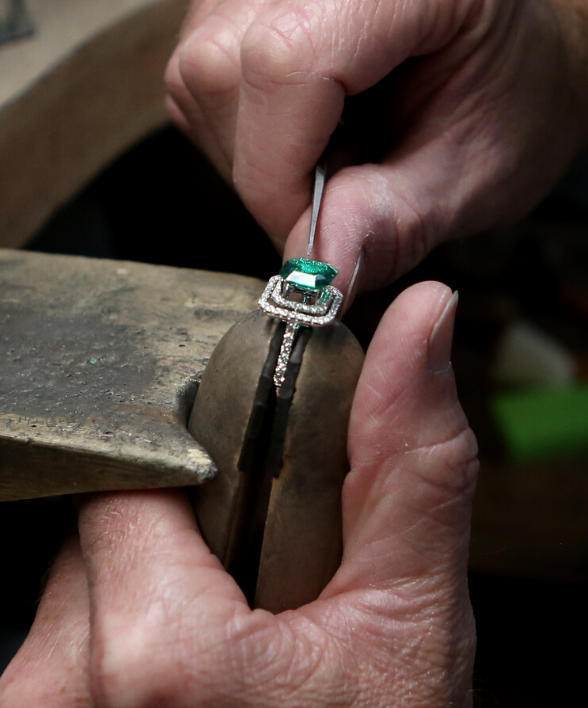
High-set rings require attentive claw audits. During routine workshop checks, our goldsmiths inspect each prong under a stereo microscope to confirm that accidental knocks have not bent the claws away from the diamond’s girdle. For low-set rings, we check the under-gallery to clear compacted soap and lotion residues that can accumulate in the tight space between the diamond culet and the skin, restoring the stone's original light return.
Our workshop team in Aberdeen can help you test high and low profiles against sample wedding bands, assess your daily routine, and choose the right mount in our showroom or online.
Frequently Asked Questions
What does it mean for an engagement ring to be wedding ring friendly?
A wedding-ring-friendly (or wed-fit) mount is engineered with its central diamond basket or collet elevated just high enough off the finger to allow a standard, straight wedding band to slide completely flush alongside the engagement ring shank without hitting metal obstructions or leaving a gap.
Are high-set engagement rings more likely to lose diamonds?
High settings place prongs higher above the finger, increasing the frequency of accidental knocks against door frames, car doors, and countertops. While the setting is structurally secure when well-crafted, regular high-impact collisions can bend claws outward over time, requiring more frequent workshop claw inspections.
Can I wear a straight wedding band with a low-set engagement ring?
Wearing a straight band with a low-set basket usually creates an open gap between the two rings because the diamond's low basket pushes the wedding ring away. To eliminate this gap, buyers can choose a fitted or contoured wedding band shaped to curve around the basket, or wear the rings on separate hands.
Which ring setting height is better for healthcare workers or active lifestyles?
A low-profile setting—such as a low four-prong basket, rub-over bezel, or cathedral mount—is significantly better suited for healthcare professionals, athletes, and anyone who wears latex gloves or works with their hands. Low mounts sit close to the skin, eliminating catch points and glove tearing.