

 Rings
Rings
 Earrings
 Bracelets & Bangles
 Necklaces & Pendants
 Silver Jewellery


 Our Story
 Diamond Buying Guide
 Watch Buying Guide
 Product Care & Aftercare
 Visit our Showroom
Browsing engagement ring styles often starts with aesthetics: looking at photographs of diamond cuts, exploring vintage engravings, and gathering ideas from social media. While visual taste matters, an engagement ring is not an occasional cocktail accessory meant to stay inside a jewellery box. It is worn through commute rushes, keyboard typing, gym routines, weekend gardening, and daily chores across decades of continuous movement.
At the goldsmith's bench, ring design is an exercise in structural engineering. When crafting mounts for engagement rings, our workshop team evaluates how setting profiles interact with daily routines. Comparing the three most enduring setting styles—the architectural solitaire, the radiant halo, and the balanced trilogy—clarifies how claw counts, side stone placements, and under-gallery depths perform under the physical demands of your partner's everyday life.
The Classic Solitaire: Minimalist Focus and Everyday Simplicity
The solitaire remains the definitive engagement ring profile, focusing visual attention entirely on a single centre diamond secured by a plain or accented metal shank.
Lifestyle Performance: Solitaires with plain platinum or 18-carat gold bands offer the highest functional resilience of any setting architecture. With no side stones or delicate pavé tracks to inspect, the mount has minimal surface area to trap soap scum or snag on knitwear. For healthcare workers, designers, or anyone whose hands are constantly in motion, a low-set solitaire provides clean ergonomics with minimal maintenance.
Bench Maintenance: Routine care for a plain solitaire is straightforward. Goldsmiths have only four or six prongs to inspect, and resizing the lower band up or down two full sizes can be performed without disturbing the central setting. Cleaning the pavilion facets beneath the diamond takes minutes using warm water and a soft-bristled brush.
The Trade-Off: Because the centre diamond sits alone, the cut grade and optical symmetry of the stone are fully exposed. Any darkness, light leakage, or visible inclusion has nowhere to hide, meaning your budget must prioritise an Excellent or Ideal cut.
The Halo Setting: Maximum Visual Presence and Intricate Craft
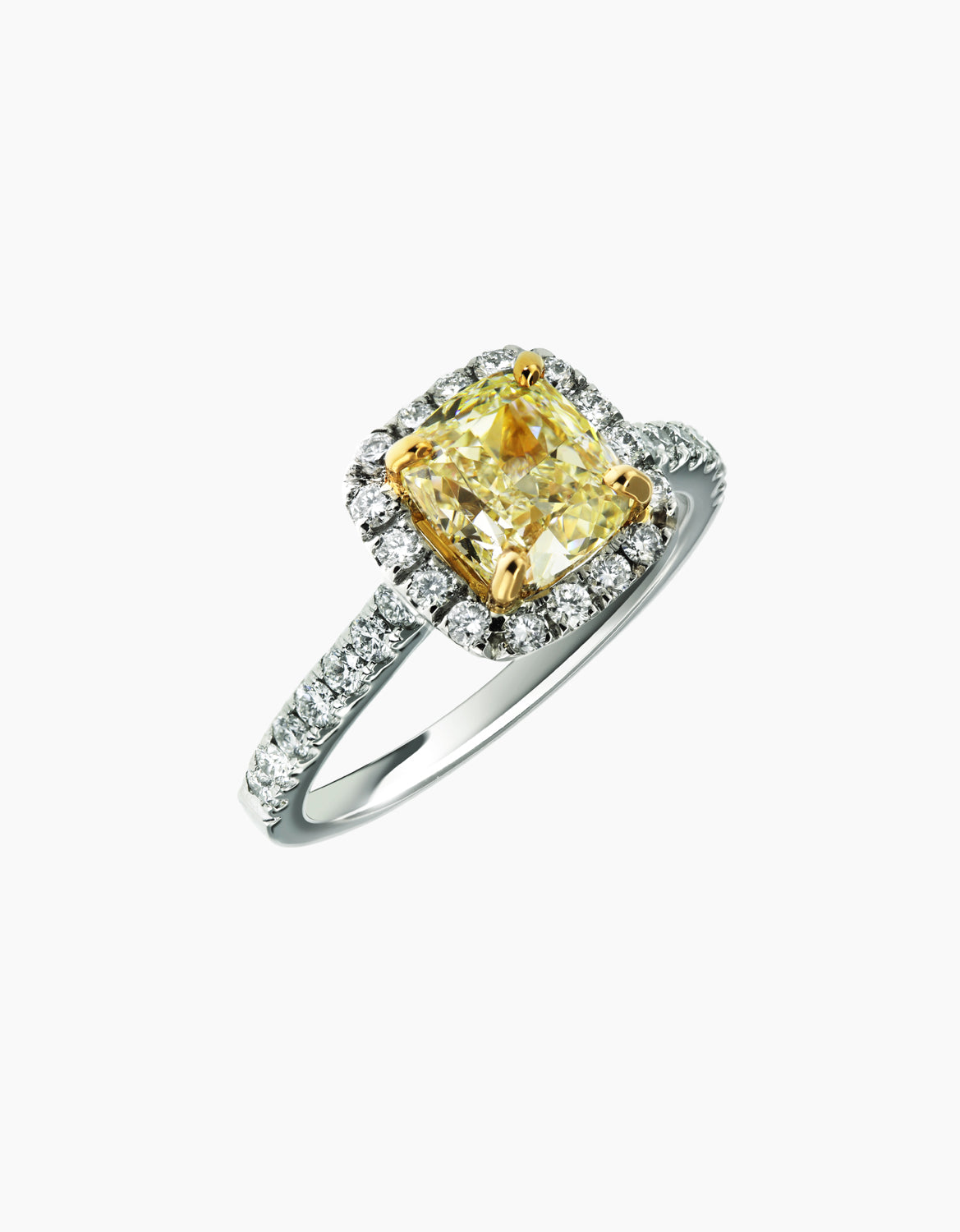
A halo mount surrounds the central gemstone with a concentric border of smaller, calibrated micro-brilliant diamonds set into an 18ct gold or platinum perimeter frame.
Lifestyle Performance: Halos deliver exceptional visual impact. By wrapping a border of diamonds around the centre stone, a halo expands the total face-up diameter of the setting by 2.0 to 3.0 millimetres. This gives a 0.75-carat diamond the physical footprint of a 2.00-carat gem on the hand. However, this extra surface area creates a broader head that sits wider across the finger, which can catch on tight coat sleeves or gloves if set high.
Bench Maintenance: Halo settings require consistent workshop attention. A standard halo contains twenty or more micro-pavé diamonds, each secured by microscopic beads of gold or platinum. A hard knock against a granite worktop or tiled floor can bend these tiny beads, risking the loss of an accent stone. Cleaning a halo also demands extra care, as grime accumulates in the dozens of tiny open seats beneath the accent diamonds.
The Trade-Off: While cost-effective for expanding visual spread on a modest budget, halo designs require an owner willing to commit to annual claw audits and mindful wear during active tasks.
The Trilogy (Three-Stone) Setting: Finger Coverage and Balanced Proportion
The trilogy setting features a central diamond flanked by two supporting side stones, traditionally representing a couple's past, present, and future.
Lifestyle Performance: Trilogy rings excel at lateral finger coverage. Rather than isolating mass in a single tall point, the three stones span horizontally across the width of the finger, creating substantial sparkle without requiring an excessively high basket. The stepped side stones act as natural metal and stone ramps, helping the ring glide smoothly under clothing and reducing the snagging common to tall single heads.
Side Stone Configurations: The character of a trilogy ring changes based on the side stones chosen:
- Round Brilliants: Create a continuous river of circular brilliance, graduating naturally from the center stone down to the shank.
- Tapered Baguettes: Offer clean, step-cut geometric lines that draw the eye inward, directing focus straight to the centre diamond like architectural arrows.
- Pear or Marquise Cuts: Point outward toward the sides of the hand, creating a soft transition that flatters shorter fingers.
Bench Maintenance: Trilogy rings require balanced tension across multiple setting baskets. If designed as a "wed-fit" mount, a straight wedding band can slide alongside; however, traditional low three-stone baskets often require a subtly contoured wedding band to achieve a flush fit.
Side-by-Side Comparison: Setting Profiles Across Daily Routines
The table below contrasts the physical attributes, maintenance needs, and lifestyle suitability of all three settings.
| Setting Style | Visual Footprint | Snag & Impact Risk | Annual Bench Maintenance | Ideal Everyday Lifestyle |
|---|---|---|---|---|
| Solitaire (Plain Band) | Focused entirely on centre diamond diameter | Low to Moderate (Height dependent) | Minimal; inspection of 4 or 6 main prongs | Healthcare, sports, manual crafts, and outdoor work |
| Halo Mount | Maximum spread; adds 2-3mm to head diameter | Moderate to High; wider perimeter frame | High; inspection of 20+ micro-pavé claws | Corporate, design, creative, and evening-focused wear |
| Trilogy (Three-Stone) | Broad horizontal finger coverage across the hand | Moderate; side stones act as ramp deflectors | Moderate; inspection of 3 stone baskets | Professional routines, teaching, desk work, and travel |
Matching Settings to Hand Anatomy and Finger Proportions
Beyond daily routines, the physical proportions of your partner's hands should guide the setting choice.
For slender or petite fingers (UK ring sizes I through L), a large halo can sometimes look overwhelming, making the ring appear disproportionately heavy on the hand. A delicate four-prong solitaire or a petite trilogy with tapered baguette side stones preserves balance, flattering the natural line of the finger.
For wider fingers or broader hands (UK sizes O through S), a standard 0.50-carat solitaire can look lost against the surface area of the hand. In these cases, a trilogy setting or a cushion halo provides broad lateral coverage, filling the width of the finger naturally and creating a balanced silhouette.
Wedding Band Compatibility: Planning the Complete Stack
An engagement ring is only the first half of a bridal set. When choosing between solitaire, halo, and trilogy settings, consider how each interacts with a wedding band.
Most modern solitaires are engineered as "wed-fit" designs, meaning the central collet is lifted just enough for a straight wedding ring to sit flush without gaps. Halos and older trilogy mounts, by contrast, frequently feature low-slung baskets that extend outward past the shank. Pairing these with a straight wedding band leaves a noticeable triangular gap.
If your partner desires a flush, gap-free stack, verify that the setting has sufficient bridge clearance beneath the head, or prepare to commission a bespoke contoured wedding ring crafted to hug the curves of the halo or side stones.
Workshop Inspection and Bench Support
Whichever setting style fits your partner's lifestyle, regular bench care ensures the precious metal and gemstones remain secure.
Our Aberdeen workshop provides complimentary annual claw inspections, ultrasonic cleaning, and stone setting audits for all engagement rings. Our goldsmiths check claw tension under high magnification, clear compacted lotions from under-galleries, and ensure the mount continues to perform reliably throughout decades of daily wear.
Our workshop team in Aberdeen can help you compare solitaires, halos, and trilogies side-by-side, test wedding band fits, and evaluate your partner's lifestyle in our showroom or online.
Frequently Asked Questions
Which engagement ring setting is the lowest maintenance for an active lifestyle?
The classic solitaire with a plain metal band is the lowest-maintenance setting. Featuring only four or six central claws and no accent pavé, it presents the fewest catch points, cleans easily with warm water, and offers the simplest path for future re-polishing or resizing.
Do halo engagement rings lose small diamonds easily?
Halo rings use micro-pavé settings where tiny gold beads secure calibrated accent diamonds. While structurally sound when well-crafted, dropping the ring onto hard surfaces or catching the frame can displace those microscopic claws. Routine annual workshop checks ensure micro-beads remain tightly burnished over every stone.
What is the traditional symbolism behind a trilogy ring?
A trilogy or three-stone ring traditionally represents a couple's past, present, and future. The centre stone is typically the largest, symbolising the present moment, flanked by two proportional side stones representing shared history and future commitments.
Can a halo ring make a modest centre diamond look bigger?
Yes. A perimeter halo of micro-brilliant diamonds adds roughly 2.0 to 3.0 millimetres of total diameter to the head of the ring. From a distance, this creates the visual footprint of a single diamond that is one to two carats larger than the actual centre stone.