

 Rings
Rings
 Earrings
 Bracelets & Bangles
 Necklaces & Pendants
 Silver Jewellery


 Our Story
 Diamond Buying Guide
 Watch Buying Guide
 Product Care & Aftercare
 Visit our Showroom
Navigating the technical paperwork that accompanies a fine diamond can feel like deciphering an engineering schematic. When reviewing loose stones or finished rings, buyers are presented with folded laminated documents covered in percentages, millimeter measurements, plot diagrams, and letter grades. Sales staff often treat the piece of paper as the product itself, claiming that a high-tier grade on a certificate automatically guarantees a spectacular, fiery diamond on the hand.
At the gemmological bench, a laboratory report is a blueprint, not an aesthetic judgment. When sourcing diamonds for engagement rings, our specialists treat independent certification from the Gemological Institute of America (GIA) as an indispensable baseline of origin, weight, and proportion. Understanding what a GIA dossier proves—and recognizing the critical optical details it leaves off the page—allows you to evaluate a stone with scientific confidence while protecting yourself from misleading commercial lab grading.
What the GIA Is: Non-Profit Scientific Authority
Founded in 1931, the Gemological Institute of America is an independent, non-profit public-benefit institution. Unlike retail jewellers or commercial grading companies, the GIA does not buy, sell, or appraise gemstones, nor does it assign monetary retail values to diamonds. Its sole purpose is scientific research, education, and standardisation.
In 1953, the GIA transformed the global gemstone industry by inventing the International Diamond Grading System—the universal standard of the "4Cs" (Carat Weight, Colour, Clarity, and Cut) and the alphabetical colour scale running from D to Z. Because the institute operates with strict double-blind testing protocols, where multiple gemmologists evaluate every stone independently without knowing the client’s identity, a GIA report is regarded internationally as the gold standard of objective assessment.
The Anatomy of a GIA Report: Key Sections Decoded
A standard GIA Diamond Grading Report or Diamond Dossier breaks down a stone into four primary operational sections.
- General Information & Verification: Records the unique GIA Report Number, issue date, cutting shape (such as Round Brilliant or Oval Brilliant), and exact physical dimensions measured to hundredths of a millimetre (e.g., 6.45 - 6.48 x 3.98 mm).
- The 4Cs Assessment: The objective laboratory grades for Carat Weight (measured to three decimal places), Colour Grade (D to Z scale), Clarity Grade (Flawless to I3), and—for standard round brilliants—the overall Cut Grade (Excellent to Poor).
- Proportions Diagram: A precise cross-section graphic showing the diamond's mathematical anatomy: table percentage, depth percentage, crown angle, pavilion angle, girdle thickness, and culet size.
- Finish and Fluorescence: Evaluates Polish (smoothness of facet surfaces) and Symmetry (exact alignment of opposing facets), followed by Fluorescence—the stone's tendency to emit a soft glow under long-wave ultraviolet light.
Laboratory Consistency: GIA vs. Commercial For-Profit Labs
Not all diamond certificates carry equal authority. In the global trade, substantial differences exist between non-profit research institutes and commercial for-profit grading laboratories.
| Grading Body | Institutional Structure | Grading Consistency & Strictness | Market Price Impact |
|---|---|---|---|
| GIA (Gemological Institute of America) | Non-profit educational and scientific institution | Benchmark strictness; double-blind assessment protocols ensure zero grade inflation. | Commands the highest market liquidity and trade confidence globally. |
| AGS (American Gem Society Laboratories) | Non-profit research body (now integrated with GIA) | Renowned for rigorous numerical cut grading (0 to 10 scale) and ray-tracing performance. | Equally respected; high market integrity. |
| IGI (International Gemological Institute) | Commercial for-profit laboratory network | Widely used for lab-grown diamonds and high-volume commercial jewellery; generally consistent, though historically softer on natural colour. | Modest trade discount compared to equivalent GIA-graded natural diamonds. |
| EGL / Unregulated Commercial Labs | Private, for-profit independent businesses | Consistently lenient; frequently grades colour and clarity 1 to 2 full tiers above GIA standards. | Significant market discount; a certificate grade cannot be compared directly to a GIA report. |
The Microscopic Laser Inscription: Linking Stone to Paper
A diamond certificate is only valuable if you can prove it belongs to the physical stone in front of you. To prevent diamond substitution or fraud, the GIA micro-inscribes the unique report number directly onto the diamond's outer girdle using cold ultraviolet lasers.
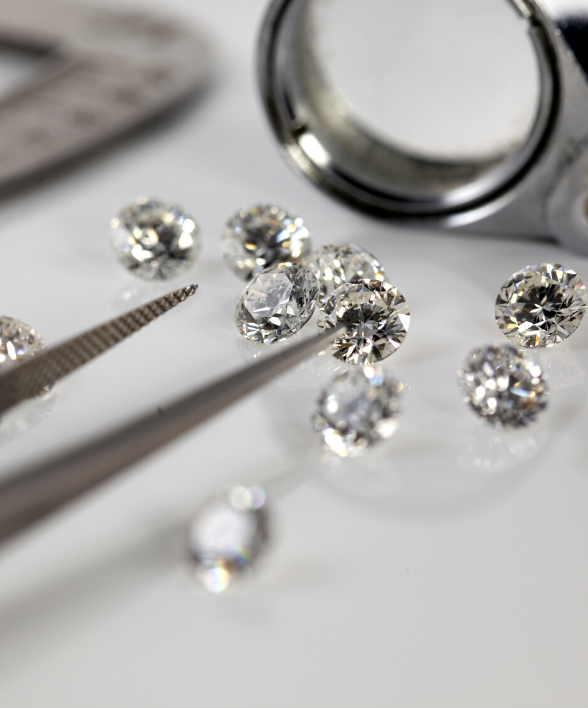
The characters of a GIA laser inscription are microscopic—measuring just a few microns in height. They cannot be seen with the naked human eye and do not affect the stone's clarity grade or brilliance. Under a 10x or 20x jeweller's loupe, however, the crisp GIA logo and matching serial number become clearly visible along the faceted edge of the girdle.
During an in-person viewing, a specialist should always position the diamond under a microscope to let you cross-reference the number etched on the stone against the printed certificate and the live GIA online archive.
The Inclusions Plot Diagram: Mapping Internal Characteristics
Full GIA Diamond Grading Reports for larger stones include a plotted diagram showing a top-down and bottom-up wireframe map of the diamond. Graders use standardized red symbols for internal inclusions (such as crystals, clouds, and feathers) and green symbols for external surface blemishes (such as polish scratches or natural rough patches).
This plot acts as a unique fingerprint. No two natural diamonds have identical crystalline growth patterns. Reviewing the plot reveals critical information that the clarity grade alone cannot communicate:
- Inclusion Location: Shows whether a crystal sits directly under the central table facet where it catches the eye, or sits safely near the outer girdle where an 18ct gold or platinum claw can conceal it.
- Inclusion Type: Differentiates between harmless translucent pinpoints and potentially risky surface-reaching feathers that could compromise durability if struck hard.
What a Certificate Cannot Tell You: The Limitations of Paper
While a GIA report provides vital scientific data, it cannot replace physical, human evaluation. A certificate does not record several optical nuances that dictate how a diamond actually looks on the hand:
- Whether the Stone is Eye-Clean: The GIA grades clarity strictly under 10x magnification. It does not state whether an SI1 inclusion is invisible to the unaided eye in natural daylight, or stands out as a visible dark dot.
- Fancy Shape Cut Performance: The GIA assigns cut grades (Excellent to Poor) only to standard round brilliants. For fancy shapes—such as ovals, pears, and emerald cuts—the GIA grades only Polish and Symmetry. It provides no cut grade, meaning the report cannot tell you whether an oval suffers from a dark bow-tie shadow.
- Lustre and Crystal Transparency: Diamonds with dense internal graining or microscopic sub-microscopic clouds can appear milky, hazy, or oily, even with a high clarity grade. This material haziness is not captured on a standard grading chart.
Workshop Inspection: Pairing Science with Master Bench Craft
A certified diamond is an extraordinary piece of natural earth history, but its ultimate beauty depends on how it is mounted into fine metal.
In our Aberdeen showroom, every client has the opportunity to inspect certified diamonds under professional stereomicroscopes, verify laser inscriptions on the girdle, and view loose stones under natural northern daylight. Our bench goldsmiths examine the proportion measurements on the GIA report to design custom collets that protect delicate girdle edges and position claws to highlight maximum light performance.
You can inspect GIA-certified diamonds, review grading reports under magnification, and consult our non-commissioned team in our Aberdeen showroom or explore our collection online.
Frequently Asked Questions
Is a diamond certificate the same thing as an insurance valuation?
No. A diamond grading report from an independent scientific laboratory like the GIA contains zero monetary values. It is strictly an objective, scientific assessment verifying the stone's natural origin, carat weight, colour grade, clarity grade, cut proportions, and physical dimensions. An insurance valuation is a separate retail document assigning a current financial replacement cost based on market metal prices and gemstone value.
Can a GIA grading report be faked or cloned?
While counterfeit physical paper certificates exist in secondary markets, every genuine GIA report features security safeguards including micro-printing, chemical-reactive paper, and a unique QR code. Crucially, any report can be instantly cross-referenced against the GIA's official online global database using the specific report number, and matched to the microscopic laser inscription on the diamond's girdle under a 10x loupe.
Why do some laboratories grade the exact same diamond more generously than the GIA?
Different commercial grading laboratories use varying standards and thresholds. While non-profit institutions like the GIA and AGS operate with strict scientific consistency, certain for-profit laboratories grade colour and clarity one to two grades softer. A stone certified as F/VS1 by a lenient commercial lab may only achieve an H/SI1 when assessed by the GIA.
Does a GIA report tell me whether a diamond is eye-clean?
No. A GIA certificate provides a clarity grade based on laboratory examination under 10x magnification, along with a two-dimensional plotted diagram showing the location and nature of inclusions. It does not state whether those features are visible to the naked human eye in natural daylight, which is why hands-on gemmological inspection remains essential.