

 Rings
Rings
 Earrings
 Bracelets & Bangles
 Necklaces & Pendants
 Silver Jewellery


 Our Story
 Diamond Buying Guide
 Watch Buying Guide
 Product Care & Aftercare
 Visit our Showroom
How do Italian goldsmiths and artisan workshops ensure precision craftsmanship in motifs like the Horsebit and Interlocking G?
When you hold a piece of fine Italian jewellery in your hands, the first thing you notice is not simply the brilliance of the metal or the sparkle of a gemstone. It is the balance. The way a clasp clicks shut with a clean, reassuring snap, how curved links sit effortlessly against the collarbone, and the absence of any sharp edges or rough casting seams speak volumes before you even inspect the maker's mark. For world-renowned design houses, translating high-fashion symbols into fine jewellery requires an extraordinary level of technical discipline. In our detailed Gucci jewellery guide, we explore how iconic emblems transcend seasonal trends to become permanent fixtures of luxury design. Behind emblematic signatures like the Horsebit and the Interlocking G lies a quiet army of master goldsmiths working across Italy's historic manufacturing districts, transforming graphic motifs into miniature feats of mechanical engineering.
Creating recognisable emblems in precious metals is far more difficult than producing abstract jewellery shapes. When a design relies on strict geometric symmetry or recognisable real-world hardware, the human eye instantly spots the slightest flaw. A fraction of a millimetre's deviation across the curve of an Interlocking G makes the emblem look distorted; a poorly calibrated hinge on a Horsebit bracelet causes the links to bind, pinch the skin, or drape awkwardly. To understand how these pieces achieve their fluid movement and mirror-like surfaces, one must step inside the traditional Italian workshops of Valenza, Vicenza, and Florence, where generational handcrafting techniques merge seamlessly with cutting-edge micro-mechanics.
The Heritage of Italy’s Goldsmithing Capitals
Precision in Italian fine jewellery is deeply tied to geography. Italy does not rely on a single centralised manufacturing hub; instead, its goldsmithing heritage is divided into distinct regional epicentres, each celebrated for a specific mastery of precious metals:
- Valenza (Piedmont): Universally recognised as the capital of high jewellery (alta gioielleria). Valenza is home to complex stone setting, intricate one-off fabrications, and the meticulous hand-assembly of multi-part gold mechanisms.
- Vicenza (Veneto): The global benchmark for chain-making engineering, hollow-form gold production, and high-precision metallurgical science.
- Florence and Arezzo (Tuscany): Famed for artistic chasing, hand-engraving, historical metalwork, and the artistic craftsmanship that gave birth to the Renaissance bottegas.
When luxury motifs are cast and hand-finished in these districts, artisans draw upon centuries of collective guild knowledge. An apprentice goldsmith in Valenza spends years learning the exact resistance of 18-carat gold under a steel burnisher before ever working on production pieces. This innate understanding of how noble metals behave under heat, tension, and pressure allows Italian workshops to execute exacting designs that mass-production stamping plants simply cannot replicate.
Engineering the Horsebit: Articulation, Balance, and Mechanical Freedom
The Horsebit is perhaps the most celebrated emblem in Italian luxury history. Originating from the miniature double-ring and central snaffle bar of an equestrian bridle, the motif was first adapted into leather accessories and hardware before making its way into fine jewellery. If you want to explore the historical narrative behind this equestrian crossover, our deep-dive into how Gucci incorporates its rich equestrian heritage into the design of its modern jewellery collections charts its journey from saddlery to high fashion.
From an engineering perspective, the Horsebit is deceptively complex. It is not a static medallion; it is an articulated kinetic mechanism. A typical Horsebit link consists of three distinct parts: two arched rings and an interlocking central bar. To achieve effortless, tactile fluidity, Italian goldsmiths must address several mechanical challenges:
1. Invisible Tolerances and Friction Control
The central bar must pass through the rings with enough clearance to pivot freely, yet without so much room that the assembly feels loose or rattles cheaply. Master artisans work within tolerances measured in hundredths of a millimetre. If the loop is cast a hair too tight, polishing compound will wedge inside and freeze the joint; if cast too wide, the gold will experience premature wear as the parts rub together. Workshops often utilise cold-drawn gold wire for the internal hinge pins, ensuring the metal possesses maximum structural density to resist friction over decades of wear.
2. Seamless Laser Assembly
Traditional torch soldering introduces excess heat, which can soften work-hardened gold and leave visible solder seams around delicate joints. Modern Italian workshops counter this by combining traditional bench tools with micro-pulse laser welding. Laser welding allows the goldsmith to fuse the structural pins holding the Horsebit rings together under high magnification in an inert argon gas atmosphere. This prevents oxidisation, eliminates visible seams, and ensures the gold retains its high tensile strength precisely where the joint bears weight.
3. Ergonomic Draping
A flat piece of metal does not naturally sit comfortably on a curved human wrist or neck. Artisans counter this by subtly curving the underside of the Horsebit elements. While the top of the motif appears straight and true to its equestrian origins, the reverse face is gently hollowed and radiused. This anatomical curvature distributes the weight of solid 18-carat gold evenly across the skin, preventing the heavy links from rolling over or digging into the wrist.
The Geometric Purity of the Interlocking G
While the Horsebit relies on kinetic movement, the Interlocking G motif presents an entirely different challenge: geometric perfection. The emblem relies on two mirrored, overlapping letters that form an infinity-style loop. The human brain is remarkably adept at detecting asymmetries in curved shapes, meaning any irregularity in wall thickness, curve radius, or negative space immediately ruins the piece's aesthetic harmony.
To produce this motif with uncompromising fidelity, Italian artisan workshops deploy a multi-stage approach that balances digital exactness with manual hand-lapping:
| Stage of Production | Technical Process | Craftsmanship Objective |
|---|---|---|
| CAD & Micro-Milling | Five-axis CNC milling of prototype wax models | Ensures mathematical symmetry and exact kerning of both letterforms. |
| Lost-Wax Investment Casting | Vacuum-assisted centrifugal casting under inert gas | Prevents microscopic air bubbles (porosity) across large, flat gold surfaces. |
| Hand-Lapping (Lappatura) | Polishing on flat, diamond-impregnated zinc or cast-iron laps | Creates razor-sharp edge bevels without softening the geometric profiles. |
| Internal String Polishing | Hand-threading cotton cords coated in polishing rouge through voids | Achieves a mirror finish inside enclosed cut-outs without rounding the corners. |
The hand-lapping step (lappatura) is where an artisan's individual skill becomes indispensable. When gold is polished using a standard soft buffing wheel, the wheel naturally rounds over crisp corners and creates a soft, melted appearance. To preserve the bold, architectural character of the Interlocking G, Italian lapidarists use rigid, perfectly flat rotating discs. The goldsmith holds the tiny motif by hand, applying uniform finger pressure against the spinning lap to polish the planar surfaces to an absolute mirror finish while keeping the exterior bevels sharp enough to catch the light crisply.
Metallurgical Integrity: Formulating the Right Alloys
Precision craftsmanship is entirely dependent on the quality of the raw metal. Pure gold (24-carat) is far too malleable for complex mechanical jewellery; it would deform under normal wear, causing hinges to bend and clasps to loosen. Italian workshops adhere to strict state regulations, alloying pure gold with copper, silver, and palladium to produce solid 18-carat gold (750 parts per thousand).
The choice of alloy significantly impacts both durability and fabrication behaviour. In yellow gold, the ratio between silver and copper is carefully calibrated to evoke a warm, buttery tone typical of Mediterranean goldsmithing, while retaining a high surface hardness. For white gold, palladium-rich formulations are preferred in high-end workshops because they retain their crisp white sheen throughout the body of the metal, meaning the piece will not show yellowish undertones if the exterior rhodium plating naturally wears over years of love.
For those weighing different metal options, our practical comparison on what is the difference in value retention and longevity between 18ct solid gold and sterling silver Gucci jewellery highlights how the physical properties of these metals influence long-term wear and maintenance schedules.
The Lost Art of "Pulitura a Filo" (String Polishing)
One of the clearest hallmarks of true artisan Italian manufacture is found in the places nobody looks at first glance: the enclosed negative spaces within motifs. In an Interlocking G pendant or an open-link Horsebit chain, the interior voids are tiny, angular, and hard to reach. A standard workshop polishing mop cannot enter these gaps without destroying the outer edges.
To overcome this, traditional workshops in Florence and Valenza rely on an ancient technique known as pulitura a filo (string polishing):
- The goldsmith clamps the piece firmly in a wooden bench vise lined with soft leather.
- A length of heavy, untreated cotton cord is secured to the workbench at one end.
- The artisan coats the cord with an abrasive tripoli compound, threads the loose end through the motif's interior cut-out, and pulls the cord taut.
- By sliding the jewellery back and forth along the tensioned cord at precise angles, the artisan buffs the hidden interior walls of the emblem to a mirror polish.
This process is entirely manual and cannot be automated by machines. It requires time, stamina, and hand-eye coordination. Yet, when you inspect an authentic piece under a loupe, the inside walls of the motif reflect light with the same liquid clarity as the front face—a hallmark of genuine artisan dedication.
Setting Precious Stones into Structural Motifs
When high-jewellery iterations of the Horsebit or Interlocking G are adorned with diamonds or coloured gemstones, precision becomes a matter of structural engineering. The stones cannot simply be glued or pressed into place; they must be securely seated within the gold matrix without interrupting the graphic readability of the design.
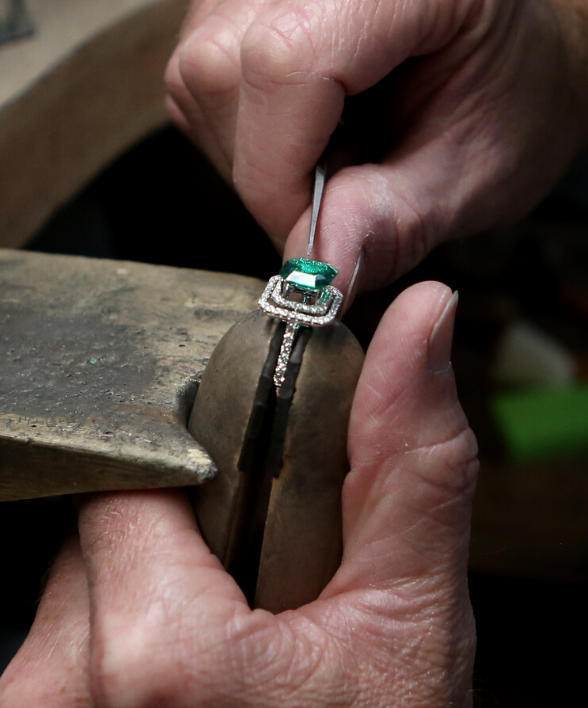
Italian diamond setters (incastonatori) work under powerful binocular microscopes, using miniature pneumatic gravers to carve delicate seats directly into the solid gold. In pavé-set variations, stones are placed culet-to-culet with almost no visible metal showing between them. The setter hand-raises tiny beads of gold (grifette) from the surrounding metal and pushes them over the diamond's girdle to lock it firmly in place. Each bead is subsequently burnished into a smooth, rounded sphere that will not snag on fine fabrics like silk or cashmere.
Crucially, setters must leave calibrated light-ports (a-jour) on the reverse side of the motif. These conical perforations allow light to enter the pavilion of each stone, maximising refractive brilliance while providing an exit channel for dirt, oils, and cleaning fluids. The back of a diamond-set Horsebit or Interlocking G motif is often just as neat and symmetrical as the front, showcasing rows of impeccably finished honeycomb fretwork.
Hallmarking, Micro-Engraving, and Quality Control
Before any finished piece leaves an Italian atelier, it undergoes a multi-point quality audit that borders on the obsessive. Goldsmiths examine every joint under high magnification, testing moving hinges against calibrated tension gauges and checking clasps for spring responsiveness.
The final step in this artisanal chain is the application of legal hallmarks and workshop identification stamps. Under Italian hallmarking legislation, every precious metal piece produced in Italy must carry two permanent marks:
- The Fineness Mark: Typically stamped inside an lozenge, such as "750" for 18ct gold or "925" for sterling silver.
- The Identification Mark (Marchio di Identificazione): A unique polygonal cartouche containing a star, an individual workshop registration number, and the two-letter provincial abbreviation (such as "FI" for Florence or "AL" for Alessandria/Valenza).
On heritage designs, these stamps are accompanied by laser-etched serial numbers and branded logotypes executed with microscopic precision. Because the walls of Horsebit links and Interlocking G frames are slender, artisans use fine-beam fibre lasers to engrave these hallmarks onto the least visible surfaces. The depth of the engraving is meticulously controlled: deep enough to withstand decades of gentle polishing, but shallow enough to avoid creating a structural weak point in the metal.
Why Italian Precision Craftsmanship Endures
In an age dominated by rapid fashion cycles and industrial automation, Italian goldsmithing workshops stand as a testament to the enduring value of patience and skill. An emblem like the Horsebit or the Interlocking G is more than an eye-catching signature; when realised by master artisans, it becomes an intricately balanced, hand-finished sculpture designed to move naturally with the human body.
By blending state-of-the-art metallurgical casting with time-honoured techniques like hand-lapping, laser welding, and string polishing, Italian workshops elevate familiar design motifs into heirloom-worthy works of art. It is this marriage of bold creative vision and uncompromising bench craft that ensures these pieces retain their structural integrity, luxurious weight, and timeless appeal for generations to come.