

 Rings
Rings
 Earrings
 Bracelets & Bangles
 Necklaces & Pendants
 Silver Jewellery


 Our Story
 Diamond Buying Guide
 Watch Buying Guide
 Product Care & Aftercare
 Visit our Showroom
Planning a surprise proposal involves balance: keeping the moment unexpected while ensuring you select a ring your partner will love. The most common technical worry is determining finger size without giving away the secret. Guessing blindly risks an awkward moment where the ring cannot slide over the knuckle during the proposal, or sits so loosely that it risks falling off the finger immediately afterwards.
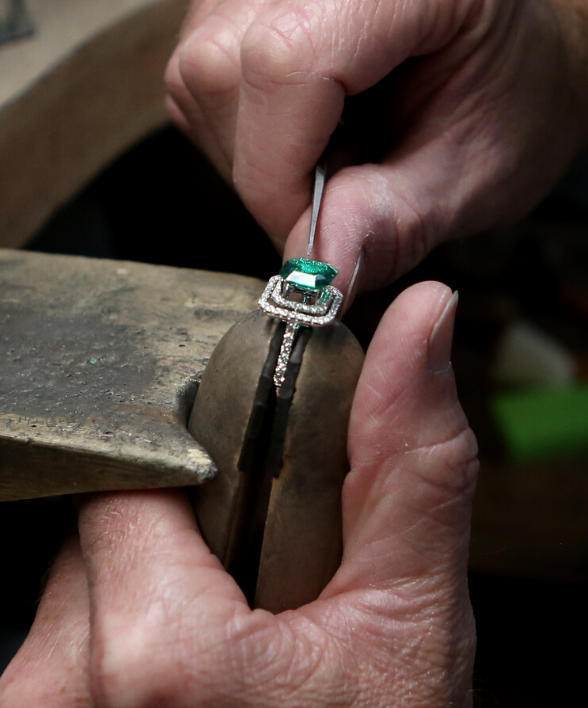
At the workshop bench, ring sizing is measured to tenths of a millimetre. When crafting mounts for engagement rings, our goldsmiths account for knuckle clearance, band width, hand dominance, and setting architecture. Relying on clumsy internet shortcuts like wrapping a wet string or paper strip around a sleeping partner's finger produces inaccurate measurements. Understanding professional bench sizing methods allows you to gather an accurate measurement discreetly while protecting the structural integrity of the ring mount.
The Anatomy of Finger Fit: Knuckles vs. Finger Base
A ring does not sit on a perfect cylinder. The human finger consists of bone joints, tendons, and fleshy tissue that react dynamically to movement and ambient temperature.
To fit properly, an engagement ring must satisfy two opposing physical requirements:
- Knuckle Clearance: The inner diameter of the ring shank must be wide enough to pass over the widest bone of the knuckle with light resistance, but without painful friction or force.
- Base Finger Stability: Once past the knuckle, the band must rest snugly against the fleshy base of the finger. If the base of the finger is significantly narrower than the knuckle, a ring sized purely for joint clearance will spin freely, causing heavy diamond settings to drop into the palm.
Goldsmiths measure rings using calibrated steel mandrels and sizing rings that account for this friction. Any covert method you use at home must replicate the rigid geometry of metal rather than the flexibility of fabric.
Covert Bench Strategies: Accurate vs. Unreliable Methods
Not all covert measurement tactics deliver reliable data. Comparing the accuracy of common approaches prevents costly sizing errors.
| Measurement Strategy | Accuracy Rating | Bench Risks & Practical Considerations |
|---|---|---|
| Borrowing an Existing Ring | High (When verified on correct finger) | Borrow a ring your partner wears on the correct hand and finger. Bring it directly to our workshop for reading on a calibrated steel mandrel. |
| The Soap or Candle Impression | Moderate to High | Press an existing ring straight down into a bar of soft soap or candle wax. Measure the inside diameter with digital callipers to tenths of a millimetre. |
| Enlisting Friends or Family | Moderate | Have a trusted friend suggest trying on costume jewellery or comparing hand sizes during a casual shopping trip to note their letter size. |
| The String or Paper Wrap Method | Extremely Low (Avoid entirely) | String stretches under tension and paper bunches over flesh; does not account for knuckle bone resistance, usually reading 2-3 sizes too small. |
| Tracing the Ring on Paper | Low | Pen tips have physical thickness (0.5mm to 1.0mm), which distorts the internal circumference measurement by several full UK sizes. |
The Borrowed Ring Method: Critical Safeguards
Borrowing an existing ring from your partner’s jewellery box is the most reliable covert method, provided you observe two essential rules.
Verify Which Finger It Fits: In the UK, engagement rings are worn on the fourth finger (the ring finger) of the left hand. If the ring you borrow is regularly worn on the middle finger, index finger, or thumb, the measurement will be substantially too large. Note which hand and finger that specific piece belongs to before bringing it in.
Account for Hand Dominance: The dominant writing hand is almost always half a size to a full size larger than the non-dominant hand due to muscle development. If you borrow a ring worn on the right-hand ring finger, our workshop team will adjust the sizing down appropriately for the left hand.
If you can borrow the ring for only an hour, slide it down your own finger and draw a sharp pen line on your skin where it comes to a firm stop. Visit our showroom, and our staff can slide calibrated sizing rings over your finger until one matches that exact line.
UK Ring Sizing System: Millimetres vs. Alphabetical Letters
The UK, Ireland, and Commonwealth countries use an alphabetical sizing system based on internal circumference, running from A for small child sizes through Z and beyond. Each full letter step represents an increase of approximately 1.25 millimetres in internal circumference, or roughly 0.4 millimetres in internal diameter.
- National Average: The average UK women's engagement ring finger measures between size L and size N (with size M being the most common median baseline).
- Quarter and Half Sizes: Professional sizing includes half sizes (such as M½) to achieve a tailored fit that prevents the band from binding during humid weather or slipping during cold winter mornings.
- Band Width Impact: A wide ring band (4.0mm to 6.0mm) covers more skin surface area, creating more friction and feeling tighter on the hand than an ultra-slim 1.8mm solitaire band of the exact same letter size. If selecting a wide mount, size up by half a letter. Center stone silhouette also plays a major role in hand proportions; explore our comparison of oval vs round brilliant diamonds to see how elongated stones affect visual finger coverage alongside band width.
Setting Types: Resizable vs. Un-Resizable Mounts
When selecting a ring under secrecy, your safety net is the mount’s ability to be adjusted after the proposal. Some setting styles allow straightforward sizing, while others cannot be altered without rebuilding the entire ring.
Easily Resizable Settings:
- Classic Solitaires: Single-stone rings with plain metal shanks in platinum or 18ct gold offer the greatest sizing latitude. A goldsmith can cut the bottom of the band, add or remove gold, solder the seam, and polish the finish without disturbing the central setting prongs.
- Three-Stone (Trilogy) Rings: Rings with a plain lower shank can typically be adjusted up or down two sizes without putting stress on stone baskets.
Settings Difficult or Impossible to Resize:
- Full Eternity Bands: Rings set with diamonds around the entire circumference cannot be cut, stretched, or compressed without releasing stones from their seats or breaking the continuous facet geometry.
- Pavé Side-Stone Bands: While rings with diamonds along the top half of the shank can be adjusted marginally (usually one size up or down), aggressive sizing bends the delicate shared claws, loosening micro-diamonds.
- Tension Settings: Rings where the diamond is held purely by the physical compression of the band’s open ends cannot be altered without compromising the balance that keeps the stone in place.
The Proposal Mount Strategy: Eliminating Sizing Stress
If your partner wears no rings, has complex joint anatomy, or you are choosing a setting style that cannot be resized easily, consider the loose diamond proposal route.
You select and purchase the certified diamond first, ensuring your budget goes directly into an Ideal cut stone with verified light performance. Our workshop mounts that diamond into a temporary, classic silver or sample solitaire mount for the proposal. Once your partner has said yes, both of you visit our Aberdeen showroom together to have her finger measured on calibrated steel sizers and collaborate on designing or choosing the permanent ring mount.
This approach preserves the romantic surprise while eliminating the anxiety of guessing finger size or selecting an unalterable ring design.
Post-Proposal Workshop Adjustments
If your secret measurement lands slightly off, standard post-proposal resizing by an on-site goldsmith is routine.
When sizing a ring down, a jeweller saws out an exact section of the lower shank, brings the open ends together, and solders the joint using matching platinum or gold solder. The ring is then rounded on a steel mandrel and polished. When sizing up, if the adjustment is minor, the band can be gently stretched on an expanding mandrel; for larger adjustments, the shank is cut open and an additional piece of matching precious metal is welded into the gap.
The chosen metal heavily impacts this bench work—review our workshop comparison of platinum vs 18ct white gold to understand how differences in metal density, thermal conductivity, and solder seams influence resizing and long-term maintenance.
Our workshop team in Aberdeen provides complimentary ring sizing on all engagement rings, ensuring the finished piece sits comfortably on the hand.
Frequently Asked Questions
Can an engagement ring always be resized after the proposal?
Most standard solitaire rings in platinum or 18-carat gold can be resized up or down by two to three full UK sizes without compromising the setting. However, full eternity bands with diamonds set around the entire circumference, tension mounts, and rings with intricate side-shank engraving cannot be resized easily and often require a full remake if sized incorrectly.
Why is using a piece of string to measure ring size so inaccurate?
String stretches when pulled taut, bends unevenly around the soft flesh of the finger, and cannot replicate the rigid circular diameter of a solid metal band. It also fails to account for the clearance needed to pass over the wider bone structure of the knuckle, almost always resulting in a ring that is ordered too small.
Is a person's dominant hand larger than their non-dominant hand?
Yes. For almost everyone, the fingers on the dominant writing hand are approximately half a size to a full size larger than the non-dominant hand due to developed muscle tone and daily use. If you borrow a ring worn on the dominant right hand, adjust down when ordering for the left ring finger.
What should I do if I am caught between two ring sizes?
Always choose the slightly larger size. It is far more graceful to present a ring that slides on easily during the proposal—even if slightly loose—than to struggle past the knuckle. Structurally, it is also safer and simpler for a goldsmith to size a ring down half a size than to stretch or add metal to size it up.