

 Rings
Rings
 Earrings
 Bracelets & Bangles
 Necklaces & Pendants
 Silver Jewellery


 Our Story
 Diamond Buying Guide
 Watch Buying Guide
 Product Care & Aftercare
 Visit our Showroom
Choosing a centre diamond for an engagement ring typically leads buyers to two popular silhouettes: the timeless round brilliant and the contemporary oval cut. Both shapes share a brilliant faceting style engineered to reflect bright flashes of white light and coloured fire, but they behave differently on the hand. First-time buyers often struggle to decide between the proven optical performance of a round cut and the elongated visual presence of an oval.
When selecting stones for engagement rings, your choice directly influences finger coverage, price per carat, optical symmetry, and setting security. Comparing the mathematical face-up spread of an oval against the calibrated light physics of a round brilliant reveals how each cut performs in natural lighting, and why inspecting oval facets in person remains essential for avoiding prominent bow-tie shadows.
The Round Brilliant: The Mathematical Standard for Light Return
Introduced to the jewellery trade in 1919 through the mathematical calculations of engineer Marcel Tolkowsky, the standard 57- or 58-facet round brilliant was engineered specifically to maximise light performance. Every angle on a round brilliant—from its 34.5-degree crown to its 40.8-degree pavilion—is calculated to bounce incoming light internally between opposing facets and return it directly through the top table facet.
Because the shape is symmetrical, grading laboratories like the Gemological Institute of America (GIA) can assign a definitive cut grade: Excellent, Very Good, Good, Fair, or Poor. When you select an Excellent cut round diamond, you receive verified mathematical confirmation that the stone reflects maximum white light (brilliance) and rainbow fire across its entire circumference, leaving no dark or dead zones. Read our detailed guide on how cut proportions dictate real sparkle to explore the anatomy, angles, and internal reflection dynamics that govern this performance.
The Oval Cut: Elongated Architecture and Carat Spread
Modern oval brilliant diamonds were developed in the late 1950s by master cutter Lazare Kaplan. By stretching the traditional round brilliant facet pattern into an elongated ellipse, Kaplan created a cut that preserves brilliant-style sparkle while distributing diamond mass differently.
Because an oval cut carries less vertical depth in its lower pavilion cone, more of its total rough crystal weight is allocated to the top surface area. This produces a greater millimeter "spread" on the hand:
- Surface Area Advantage: A well-proportioned 1.00-carat round brilliant measures roughly 6.5 millimetres across its diameter, giving a top surface area of roughly 33.2 square millimetres. An equivalent 1.00-carat oval cut typically measures approximately 7.7 x 5.7 millimetres, yielding a surface area around 36.5 square millimetres—an 8 to 10 percent increase in visible spread.
- Elongating Finger Coverage: The vertical length of an oval draws the eye along the hand, creating an elongating visual effect that complements shorter fingers or wider hands.
- Price Efficiency: Because diamond cutters can often follow the natural, oblong shapes of rough diamond crystals more efficiently when fashioning an oval, cutting yield is higher than with a round stone. This generally makes oval diamonds slightly less expensive per carat than round brilliants of equivalent colour, clarity, and weight.
Side-by-Side Comparison: Round vs. Oval Diamonds
The table below contrasts the optical, physical, and certification characteristics of both diamond cuts.
| Characteristic | Round Brilliant Cut | Oval Brilliant Cut |
|---|---|---|
| Standard Facet Count | 57 or 58 facets | Typically 56 to 58 facets |
| Visible Face-Up Spread | Standard footprint (~6.5mm diameter at 1.00ct) | 8% to 10% larger spread (~7.7 x 5.7mm at 1.00ct) |
| GIA Cut Grade Assigned | Yes (Standardized from Excellent to Poor) | No (Polish and Symmetry graded only) |
| Optical Symmetry Risk | Zero bow-tie shadow when cut to ideal proportions | Central bow-tie effect present to varying degrees |
| Visual Finger Impact | Balanced, classic circular symmetry | Elongating effect; creates a slimming silhouette |
| Price per Carat (Relative) | Highest market premium due to rough cutting loss | Typically 10% to 20% lower than round brilliants |
The Bow-Tie Effect: What It Is and How to Spot It
The primary technical consideration when evaluating an oval diamond is the bow-tie effect. Because an oval is elongated, its internal pavilion facets vary in length and angle between the narrower waist and the longer end tips. Light entering the centre of the stone bounces differently than light entering the ends.
This difference can create a shadow pattern across the middle of the table that resembles a gentleman's bow tie:
- Natural Contrast (Desirable): Every oval diamond exhibits some degree of a bow tie. In a well-proportioned cut, this pattern provides healthy contrast, alternating rapidly between bright sparkle and dark facets as the stone tilts, giving the gem depth and visual life.
- Severe Extinction (To Avoid): When an oval is cut with steep, poorly matched pavilion angles, the bow tie becomes a permanent dark patch. This dark zone blocks light from returning through the table, making the centre of the diamond look dull, glassy, or black regardless of ambient room lighting.
Because grading certificates do not evaluate cut grade or bow-tie intensity for fancy shapes, an oval diamond cannot be bought safely based on certificate numbers alone. It must be viewed in natural daylight or evaluated via high-resolution video to assess facet performance.
Length-to-Width Ratios: Finding the Right Oval Shape
Oval diamonds vary widely in their external contours. Dividing the total length of the stone by its width yields its length-to-width (L/W) ratio, which dictates the overall profile of the gem.
- 1.30 to 1.34 (Chubby Oval): A wider, fuller outline. Offers high durability and soft curves, though it provides less of an elongating effect on the finger.
- 1.35 to 1.50 (Classic Proportion): The industry standard for engagement rings. Balances graceful length with sufficient width to preserve brilliant light reflection across the waist.
- 1.55+ (Slender / Elongated): A distinctly narrow silhouette. Accentuates finger length, though stones with extreme length ratios carry higher risks of prominent bow-tie shadows and can feel vulnerable to side impacts.
Beyond shape outline, an oval's complex facet distribution also affects clarity grading. The crushed-ice sparkle pattern can naturally conceal minor imperfections better than symmetrical cuts. Follow our practical guide to buying eye-clean diamonds to identify inclusions that remain invisible to the naked eye while keeping your spend focused on carat spread.
Bench Setting Mechanics: Prongs and Daily Protection
Setting round and oval diamonds requires different techniques at the jeweller's bench to ensure the stones remain secure over decades of wear.
A round brilliant distributes impact forces evenly across its circular rim, making it suitable for classic 4-prong or 6-prong solitaire mounts. Because its perimeter is uniform, goldsmiths can seat the girdle evenly into matching prong notches with minimal risk of uneven torque.
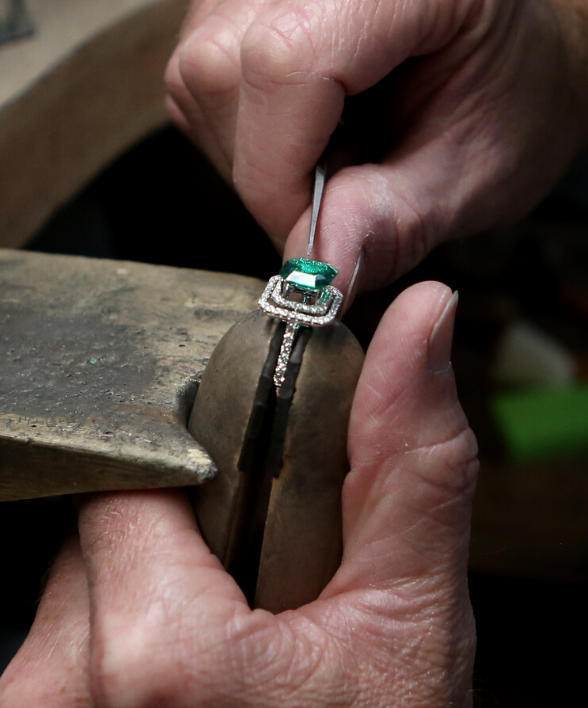
Oval diamonds require careful prong placement. The elongated ends of the stone contain shallower facet angles that can be prone to catching on knitwear or taking direct knocks. Bench setters typically secure oval diamonds using four corner prongs, six evenly spaced claws, or a protective bezel. Our goldsmiths inspect prong orientation to ensure claws grip the curved shoulders and tips securely without distorting the diamond's organic outline.
Our workshop team in Aberdeen can help you compare round and oval diamonds side-by-side under natural light, assess bow-tie patterns under magnification, and choose the ideal mount in our showroom or online.
Frequently Asked Questions
Why does an oval diamond look bigger than a round brilliant of the exact same carat weight?
Oval diamonds carry a shallower vertical depth and an elongated outline, concentrating their mass across a broader surface area. A standard 1.00-carat oval diamond provides roughly 8 to 10 percent more face-up surface area (approximately 7.7 x 5.7 mm) than a 1.00-carat round brilliant (approximately 6.5 mm diameter), creating a noticeably larger footprint on the finger.
Is every oval diamond affected by a dark bow-tie shadow?
Because of their elongated facet geometry, all oval cuts exhibit some degree of a bow-tie pattern across their central facets. In an exceptionally cut stone, this manifests as subtle, balanced contrast that flashes brightly as the hand moves. In poorly cut stones with steep pavilion angles, the bow-tie appears as a stark, dark shadow that deadens light reflection across the middle of the gem.
Do GIA certificates give an official cut grade for oval diamonds?
No. Unlike round brilliant diamonds, which receive an overall cut grade from Excellent to Poor on a GIA report, fancy shapes such as ovals receive grades only for polish and symmetry. Proportions, optical balance, and bow-tie severity must be assessed through visual inspection rather than a single certificate letter.
What is the ideal length-to-width ratio for an oval engagement ring?
Most buyers prefer a classic length-to-width ratio between 1.35 and 1.50. A ratio below 1.30 looks noticeably round and compact, while a ratio above 1.55 appears narrow and stretched, which can accentuate central bow-tie extinction.