

 Rings
Rings
 Earrings
 Bracelets & Bangles
 Necklaces & Pendants
 Silver Jewellery


 Our Story
 Diamond Buying Guide
 Watch Buying Guide
 Product Care & Aftercare
 Visit our Showroom
Navigating diamond clarity charts is often where ring budgets become unnecessarily inflated. When first-time buyers review independent grading reports, terms like "inclusion," "feather," or "internal flaw" sound alarming. The natural instinct is to pursue paper perfection, paying significant premiums for Flawless (FL), Internally Flawless (IF), or Very Very Slightly Included (VVS) grades simply to ensure the stone contains no visible blemishes.
In real-world jewellery design, diamonds are evaluated on the human hand, not under a laboratory binocular microscope. When choosing stones for engagement rings, the industry benchmark is whether a diamond is "eye-clean." Understanding how gemmological laboratories grade clarity under 10x magnification, which inclusion types actually matter, and how diamond cut masks internal features ensures you spend your budget on visible size and brilliance rather than microscopic laboratory distinctions.
The GIA Clarity Scale: 10x Magnification vs. The Human Eye
The Gemological Institute of America (GIA) established the standard 11-grade clarity scale used across global trade. Crucially, every clarity grade on that report is assigned under 10x optical magnification in controlled darkfield laboratory illumination. A grade reflects the size, relief, number, nature, and position of internal characteristics (inclusions) and surface features (blemishes).
- Flawless / Internally Flawless (FL/IF): No inclusions visible to an experienced grader under 10x magnification. These represent less than one-half of one percent of all gem-quality diamonds mined.
- Very Very Slightly Included (VVS1 / VVS2): Inclusions are so microscopic that even trained gemmologists struggle to locate them under 10x magnification. To the unaided human eye, a VVS stone is visually indistinguishable from a Flawless diamond.
- Very Slightly Included (VS1 / VS2): Minor internal characteristics such as small crystals, light feathers, or distinct pinpoints. Visible under 10x magnification, but virtually 100 percent of VS diamonds are completely clean to the naked human eye.
- Slightly Included (SI1 / SI2): Inclusions are noticeable under 10x magnification. Many SI1 stones—and selected SI2 stones—remain completely eye-clean, offering substantial value when carefully chosen by a specialist.
- Included (I1 / I2 / I3): Inclusions are obvious under 10x magnification and usually visible to the unaided eye, often diminishing diamond transparency, light return, and structural integrity.
Clarity Grade Breakdown and Real-World Visibility
The table below details how laboratory grades translate to actual hand visibility, pricing impact, and mounting practicality.
| Clarity Grade | Laboratory Definition (10x Magnification) | Naked-Eye Appearance | Budget & Purchasing Advice |
|---|---|---|---|
| FL / IF | Zero inclusions visible under 10x; IF allows minor polish blemishes on the surface. | 100% eye-clean; flawless visual transparency. | High collector premium; pays for rarity on paper that provides zero naked-eye visual advantage over VS grades. |
| VVS1 / VVS2 | Extremely difficult for an expert to see under 10x magnification; minute pinpoints or faint clouds. | 100% eye-clean; zero visible flaws from any viewing angle or distance. | Excellent for buyers who want peace of mind, but commands a steep price premium over visually identical VS stones. |
| VS1 / VS2 | Minor inclusions easily seen under 10x magnification by a grader, but small in absolute size. | 99% eye-clean; inclusions remain invisible to the naked human eye in daily daylight. | The commercial sweet spot; delivers pristine visual performance without paying for lab-only perfection. |
| SI1 | Noticeable inclusions under 10x magnification; distinct crystals, feathers, or clouds. | Frequently eye-clean (70-80% of stones), depending on stone size, cut quality, and inclusion location. | Exceptional value tier; frees up budget for higher carat weight or an Ideal cut, requiring individual gemmological vetting. |
| SI2 / I1 | Inclusions very easy to see under 10x; often centered or clustered together. | Borderline; inclusions frequently visible to the eye as dark specks, cloudy patches, or internal cracks. | Requires extreme caution; inclusions often reduce light return or threaten structural durability near setting prongs. |
Anatomy of an Inclusion: Good Inclusions vs. Bad Inclusions
Not all inclusions carry the same visual or structural weight. When reviewing diamond plotting diagrams on a certificate, gemmologists look past the grade letter to examine what the inclusion actually consists of and where it sits.
Benign Inclusions (Ideal for Eye-Clean Stones):
- Pinpoints: Tiny microscopic mineral crystals that appear as tiny white dots under magnification, completely invisible to the unaided eye.
- Translucent Crystals: Internal crystals formed from other minerals (or tiny trapped diamond crystals) that are clear, white, or light grey rather than black.
- Perimeter Features: Inclusions positioned near the outer girdle border rather than dead center under the table. A goldsmith can frequently place an 18ct gold or platinum claw directly over a perimeter inclusion, concealing it permanently within the ring mount.
Problematic Inclusions (To Avoid):
- Dark or Black Carbon Centers: Trapped graphite or dark mineral pockets sitting directly under the central table facet. These act like miniature ink dots against the bright white brilliance of the diamond.
- Dense Clouds: Tightly packed clusters of microscopic pinpoints that diffuse light, giving the diamond an oily, hazy, or milky appearance even if the stone has high colour.
- Surface-Reaching Feathers at the Girdle: Internal fracture lines that break through the thin outer edge of the stone. If an open feather sits where a setter must apply mechanical pressure with a prong, the diamond risks cleaving or chipping during mounting or daily impact.
How Diamond Cut and Faceting Geometry Mask Flaws
The facet pattern of a diamond strongly influences how easily your eye detects internal inclusions.
Brilliant-Cut Facets (Round, Oval, Cushion): A round brilliant diamond features 57 or 58 facets arranged in an intricate, multi-angled cone. When cut to Excellent or Ideal proportions, light bounces off internal mirrors in a chaotic, rapid scintillation pattern. This intense dispersion of white brilliance and spectral fire acts as optical camouflage, breaking up reflections and making small crystals or feathers invisible to the naked eye. Learn more about how cut proportions dictate real sparkle to understand the facet physics that create this optical masking effect.
Step-Cut Facets (Emerald, Asscher): Step cuts feature parallel, rectangular facets that produce a clean "hall of mirrors" reflection rather than intense sparkle. Because the top table facet is wide and flat, it acts like an unobstructed glass window straight down into the pavilion. An inclusion that remains invisible in a round brilliant will stand out clearly in an emerald cut, meaning buyers selecting step cuts must generally step up to VS1 or VS2 clarity to ensure the stone is eye-clean.
Diamond shape also dictates how inclusions interact with different silhouettes. For instance, elongated brilliant shapes distribute sparkle across varied facet lengths, which affects where inclusions can safely hide. Explore our detailed comparison of oval vs round brilliant diamonds to see how shape geometry influences both light return and internal clarity visibility.
The Value Trade-Off: Where to Allocate Your Ring Budget
Choosing an eye-clean VS2 or curated SI1 diamond over a VVS1 or Flawless stone yields significant financial savings with zero loss in visible beauty. In a typical one-carat diamond, the price jump from an eye-clean VS2 to a VVS1 of identical colour and cut can easily reach 20 to 35 percent.
Once a diamond is set into an engagement ring, nobody looking at the ring across a dinner table, in an office, or under morning sunlight can tell the difference between a VS2 and a VVS1. Both present identical white fire, sharp facet edges, and transparent clarity. By adhering to the eye-clean rule, those saved funds can be allocated where they deliver immediate, undeniable visual impact: securing an Excellent/Ideal cut grade to maximize sparkle, or stepping up to a larger carat spread.
Workshop Inspection: Verifying Eye-Clean Stones at the Bench
Because grading reports provide two-dimensional maps of three-dimensional crystals, paper certificates cannot confirm whether a borderline SI1 or VS2 diamond is truly eye-clean in natural light.
In our Aberdeen showroom, our specialists assess every loose diamond under three standard conditions:
- Face-Up Ambient Inspection: Viewing the stone at a standard reading distance (25 to 30 cm) under balanced, un-magnified daylight to confirm zero visible dark spots.
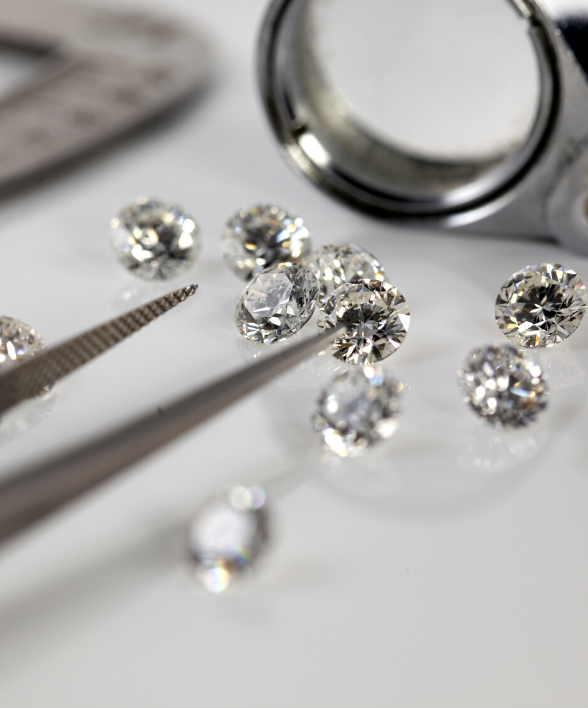
- 10x Loupe Demonstration: Guiding clients through the loupe to locate and identify internal features, confirming the stone's laser-inscribed GIA serial number against the certificate.
- Mounting Audit: Bench goldsmiths evaluate whether setting prongs, bezels, or halo frames can be strategically oriented to cover minor perimeter feathers, enhancing both security and visual clarity.
You can inspect certified diamonds under laboratory microscopes, compare clarity tiers side-by-side, and consult our non-commissioned team in our Aberdeen showroom or explore our collection online.
Frequently Asked Questions
What does the term eye-clean actually mean in gemmology?
An eye-clean diamond has no internal inclusions or surface blemishes visible to a person with normal 20/20 vision looking at the stone face-up from a distance of approximately 25 to 30 centimetres in natural ambient daylight. While microscopic characteristics exist under a 10x jeweller's loupe, they do not disrupt the naked-eye brilliance or clean transparency of the gem.
Can an SI1 clarity diamond be completely eye-clean?
Yes, many SI1 diamonds are completely eye-clean, but each stone must be evaluated individually. If the inclusion is a dispersed white feather, a tiny faint crystal away from the center table, or positioned near the outer girdle where a setting claw can conceal it, the diamond will look pristine to the unaided eye.
Which diamond shapes require higher clarity grades to look clean?
Step-cut diamonds like emerald cuts and Asscher cuts require higher clarity grades, typically VS1 or VS2. Step cuts feature long, rectangular, open facets that act like transparent windows into the center of the stone. Unlike brilliant cuts, they do not produce intense, chaotic scintillation patterns that help mask internal crystals.
Does an inclusion weaken the physical structure of a diamond?
Most minor inclusions—such as microscopic pinpoint crystals or tiny clouds—have zero impact on structural durability. However, large open cavities, deep surface-reaching fractures, or prominent feathers that break through the thin perimeter of the girdle can make a diamond susceptible to chipping if struck directly against a hard surface during mounting or daily wear.